Free Inspections & EstimatesSame Day Service

Get Spotted Lanternfly Control Near You

Spotted lanternflies? Lights out!

Feel comfortable in your home. Let Fox Pest Control take care of your spotted lanternfly problem.

Same Day Service

Free Inspections & Estimates

Satisfaction Guaranteed

Fox Pest Control technician inspecting kitchen for pests

Fox techs are experts at evicting your tiny tenants.

To ensure our customers’ safety, all Fox Pest Control technicians undergo a thorough screening process and complete extensive classroom training, along with ongoing on-the-job mentoring with an experienced technician.

The easiest way to get rid of spotted lanternflies.

Got spotted lanternflies? The best way to get rid of them is to understand how they work and use that to your advantage. Fox Pest Control specializes in spotted lanternfly control, with custom solutions and the right products to tackle the job. We’re so confident in our ability to handle your spotted lanternfly infestation that we guarantee your satisfaction. If you spot any lanternflies between treatments, just give us a call, and we’ll come back for free! That’s the Fox Guarantee!

1

Schedule with Fox

Call Fox Pest Control today for a free inspection: (855) 953-1976.
Call before 2 pm and get same-day service.

Remote locations and other conditions may require next-day service.

2

Treatment

A certified technician will inspect your property and provide customized pest control treatment based on their findings.

3

Follow Up

Each service provides a detailed report and helpful tips to keep pests away. We return regularly throughout the year, increasing protection with every visit.

Hamilton Allen Ph.D., BCE

Certified Entomologist, Fox Pest Control

Spotted Lanternfly Facts


Size: ¼ to 1-inch
Number of legs: 6
Wings: yes
Bites or stings: no
Color: black, gray, brown, red
Carry disease: no
Damages home/yard: yes
Most active season: July-December
Fox plan for this pest: Specialty Plan

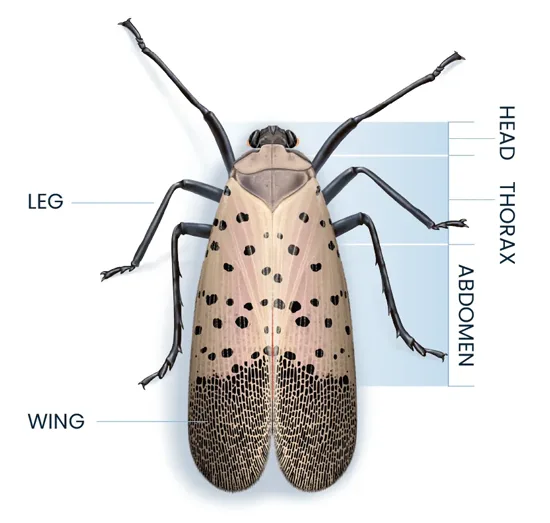
What do spotted lanternflies look like?

Spotted Lanternfly Anatomy Diagram

Spotted Lanternflies are native to China.

They were first found in Pennsylvania in 2014. They feed on various fruit, ornamental, and woody trees. Both nymphs and adults target the Tree of Heaven, grapes, apples, hops, and other crops.

Spotted lanternflies are invasive, but they do not usually fly long distances.

Instead, they hitchhike to get around. Adults may enter vehicles through open windows, while eggs can be deposited on various outdoor surfaces and easily transported to different locations.

Spotted lanternflies may be mistaken for flies or moths.

They are actually planthoppers, or true bugs, related to cicadas and stink bugs. They feed on plant sap using specialized mouthparts.

Spotted lanternfly populations are currently found in 17 states.

This includes Connecticut, Delaware, Illinois, Indiana, Kentucky, Maryland, Massachusetts, Michigan, New Jersey, New York, North Carolina, Ohio, Pennsylvania, Rhode Island, Tennessee, Virginia, and West Virginia.

To deepen your understanding of this invasive species, explore our Spotted Lanternfly Pest Files—a comprehensive guide covering their life cycle, the ecological threats they pose, and effective strategies for detection and control.


Pests that can be confused with spotted lanternflies.

The following insects have been mistaken as spotted lanternflies: Tiger moths, cinnabar moths, white-lined sphinx moths, boxelder bugs, large milkweed bugs.

You might already know for sure that you have an spotted lanternfly problem. Here are a couple of the most common signs of spotted lanternfly infestation.

Spotted lanternflies are insects with black spots on both their distinctive grayish forewings and red hindwings. Seeing adult spotted lanternflies, particularly in large numbers, indicates an infestation.

Spotted lanternflies lay their eggs in clusters on various surfaces, such as tree trunks, branches, rocks, or man-made structures. The egg masses are brownish-gray and may resemble a smear of mud or putty.

Spotted lanternflies release a sugary substance called honeydew as they feed on plants. This sticky residue can build up on surfaces beneath infested trees, attracting other insects like ants and wasps.

Heavy feeding by spotted lanternflies can cause plants to weaken, wilt, or develop yellowing or browning foliage. This damage may be particularly noticeable in trees, vines, or crops favored by insects.

Honeydew excreted by spotted lanternflies can promote the growth of sooty mold, a dark, powdery fungus that may appear on surfaces beneath infested trees.

Spotted lanternflies prefer to feed on the invasive tree of heaven (Ailanthus altissima), a primary host plant for egg-laying and nymph development. Infestations may be more common in areas with abundant Tree of Heaven populations.

In areas where spotted lanternfly infestations are established, authorities may issue quarantine notices to prevent the movement of potentially infested items such as outdoor furniture, firewood, or vehicles to unaffected areas.

Learn to identify them

Remove any tree-of-heaven

Check for and destroy egg masses

Avoid transporting egg masses or nymphs

Encourage natural predators

People like us.
Pests don't.

4.72 Average | 45,000+ Reviews

Bryan A.

I could not be more pleased with our initial home treatment today! Vincent arrived on time and was extremely thorough in his explanation of the services he performed. He was very polite, respectful of our inside spaces, and had a great attitude throughout the visit. A++ professional! Thank you!

Kayla B.

Overall - very satisfied with communication and job done for my first time ever hiring pest control. Very knowledgeable and explains everything. Makes it very easy to maintain for a super busy family like ours.

Fox Guarantee: We Come Back for Free!

    What type of property do you need help with?

    Are you a current customer?


    By clicking the checkbox, I am providing my eSign signature and consent to Fox Pest Control contacting me at the number above for marketing purposes including through the use of automated technology, SMS/MMS messages, and prerecorded and/or artificial voice messages (including AI generated messaging).  I acknowledge my consent is not required to purchase and I can connect with Fox Pest Control without providing consent by calling 833-667-3785. Message frequency may vary, and message & data rates may apply. Reply 'STOP' to unsubscribe. Reply 'HELP' for help. I also agree to the Fox Pest Control Privacy Policy and Terms of Use.

    Fox Pest Control technician talking to female customer

    Spotted Lanternfly FAQs

    How does Fox treat spotted lanternflies?

    Some pests are unique and require special Pest Control services. At Fox Pest Control, we offer specialty treatments for pest problems, such as bed bugs, moles, voles, and, in some areas, spotted lanternflies. For more information on how we can help you with your spotted lanternfly problem, call us today!

    What to do when you find a spotted lanternfly?

    If you find a spotted lanternfly, it’s essential to take action to prevent its spread:

    • Report it: Report sightings to your local agricultural extension office, Department of Agriculture, or online databases dedicated to tracking invasive species.
    • Remove them: If possible, carefully capture and dispose of the spotted lanternfly. Squashing them is an option but be cautious as they may release a foul-smelling liquid when threatened.
    • Destroy egg masses: Scrape off and destroy egg masses found on surfaces such as tree trunks, branches, or outdoor furniture.
    • Prevent Spread: Avoid transporting infested materials or items containing egg masses to new areas. Check outdoor gear, vehicles, and furniture for signs of infestation before moving them.

    Fox Pest Control offers a specialty service for spotted lanternflies in select markets. Call today to find out if we can help you with this particular pest.

    Why are spotted lanternflies bad?

    Spotted lanternflies are harmful because they eat the sap of many plants, weakening or killing them and harming farms and natural areas. They also spread quickly, taking over places they don’t belong and hurting local plants and animals. They can travel far with humans, making the problem worse. While spotted lanternflies may seem small, they can cause big problems for our plants and trees if they’re not kept in check.

    Where do spotted lanternflies go at night?

    Spotted lanternflies typically rest at night, seeking shelter in trees, shrubs, or other vegetation. They may also seek shelter in man-made structures such as buildings, outdoor furniture, or vehicles. They are less active at night and often stay hidden to avoid predators and adverse weather conditions.

    Are spotted lanternflies dangerous?

    Spotted lanternflies are not dangerous to humans in the same way that other insects, like mosquitoes or ticks, can be. They don’t bite or sting people, and they don’t carry diseases. However, spotted lanternflies can harm plants and trees, causing problems for farmers, gardeners, and the environment. So, while spotted lanternflies aren’t dangerous to us, they can still cause a lot of trouble for our plants and the places where we live.

    What do spotted lanternflies eat?

    Spotted lanternflies like to feed on the sap of various plants and trees. They’re not picky eaters and will feed on many types of trees, including fruit, ornamental, and hardwood trees. Their favorite food is a tree called the Tree of Heaven, but they also enjoy grapes, apples, hops, and other crops.

    Do spotted lanternflies bite?

    Spotted lanternflies don’t bite people or animals. However, if you try to touch or handle them, they might release a smelly liquid that can irritate your skin. Even though spotted lanternflies might seem a little scary because of their looks, they won’t harm you by biting or stinging.